How we gather.
Why it heals.
We are harmed in relationship.
We are healed in relationship.
This is not a metaphor. It is the shape of how human beings are made.
We are not isolated souls who happen to share a planet. We are people formed in the image of a triune God, a God who has always existed in relationship, whose very nature is communion. Which means we are, at the core of what we are, relational beings.
And because we are relational, most of what has wounded us has come through relationship. A parent who could not stay. A church that turned away. A marriage that named cruelty as holiness. A room full of people who never asked to know you.
Information does not undo that. A framework does not undo that. Not even the right Scripture, delivered at the right moment, undoes that.
What begins to undo it is being witnessed. Being known. Being held in the telling of what actually happened, by people who do not turn away.
Researchers, therapists, and spiritual directors who have spent decades in this work—Curt Thompson, Adam Young, the practitioners at the Center for Being Known, The Allender Center, Freedom Movement, the Center for Embodied Faith, among others—have arrived at the same conclusion from different directions: we cannot fully heal in isolation. We need embodied presence. We need people who will stay. Story Liturgy is how Between Grief & Glory creates that kind of room.
FROM THE FOUNDER
The twenty minutes that undid me
When I first entered this kind of story work, finally for myself, not for the women I serve, I was challenged to allow myself to be seen. Not for an hour. Not for a full session. Twenty minutes.
And it was one of the hardest things I have ever done.
I had spent years consuming the right resources, collecting tools, learning frameworks. I thought I was healing. What I was doing was staying ahead of the thing I had not yet let anyone see.
Then I let women stay with me. Women I did not trust. Women I had not chosen. Women I was certain would eventually look away. And when they did not look away, something shifted in me that no book had ever touched.
They helped regulate what I could not regulate alone. Their faces did not turn away. I came home that night and felt the pull toward the old pattern—the numbing, the closing off. And underneath it I felt something different. Disappointment. I don't want to do this anymore.

I got on the phone with a friend. For the first time, I told the truth. Not a partial. Not a version I could manage. A real piece of what had happened to me. And she received it.
That moment reaffirmed everything. I need people. I need presence. I need to speak the truth and have it witnessed.
That is what I am building here. For you.
THE FOUNDATION
What makes a room like this work
Not every gathering heals. Some rooms re-wound. The difference is not the topic or the teacher. The difference is the quality of presence in the room, and the structure that holds it.
Every BGG cohort is built on six convictions about what a healing community requires.
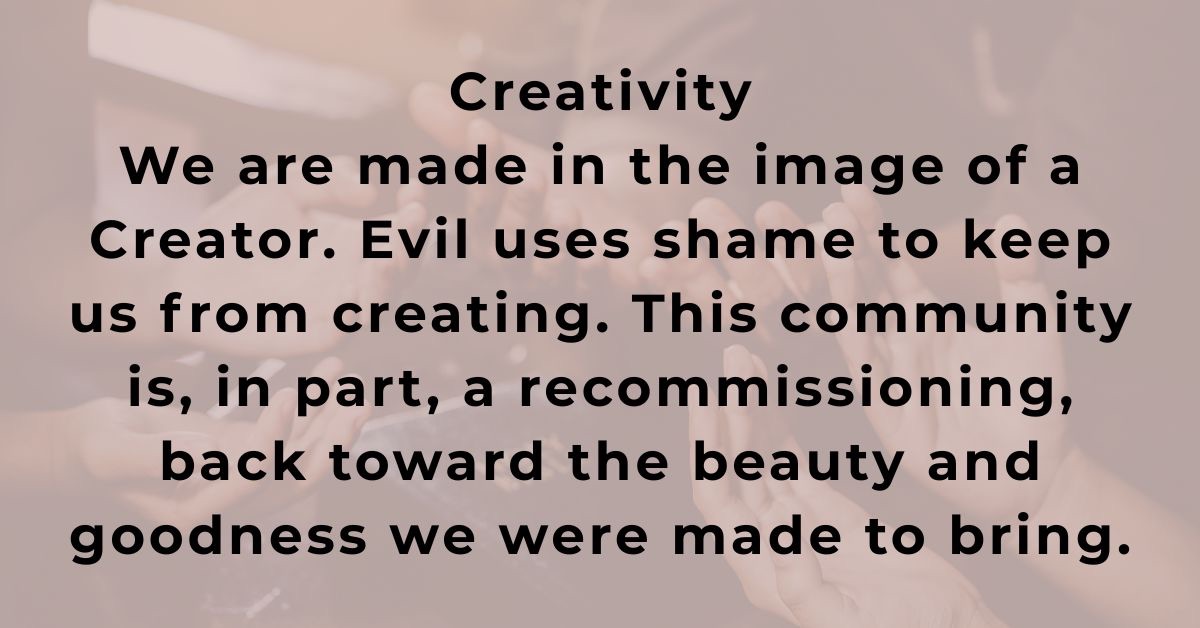
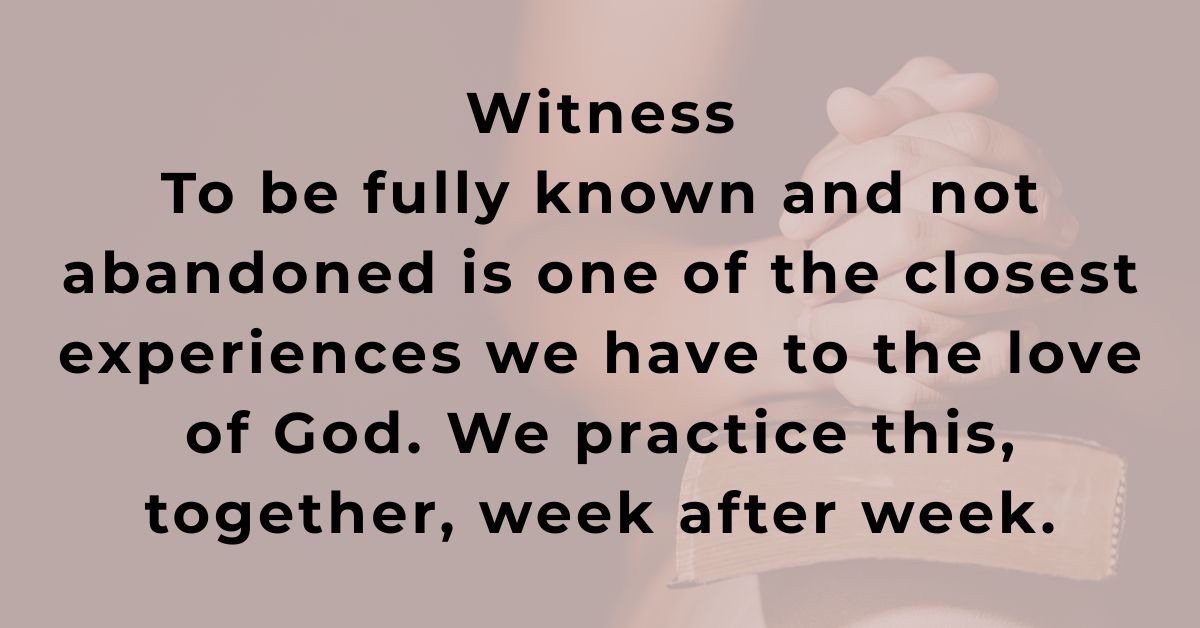
These convictions are grounded in the work of therapists, spiritual directors, and researchers who have spent decades studying what actually heals—among them Curt Thompson, MD, whose work on confessional community and the neuroscience of being known has shaped this approach. Story Liturgy is Between Grief & Glory's application of these principles into a structured, sacred practice.
THE PRACTICE
Your Story Seen: how we gather
Every BGG cohort, regardless of which program you are in, follows the same gathering rhythm. We call it Your Story Seen. It is a structured, sacred practice that repeats each session, so that over time, showing up fully becomes easier. The format carries you when the words feel hard to find.
This is not a Bible study. It is not a support group. It is a space where story is honored as the medium through which God works, and where being witnessed is treated as a spiritual practice, not just a conversation.
I. Arrive & Ground
We do not rush into content. We arrive first. Each session opens with a brief grounding practice—an invitation to release what you carried in from the rest of your day and settle into the present moment together. You do not have to arrive ready. You only have to arrive.
II. Reflect & Discuss
After grounding, we open space for the content of this week's session. Questions, observations, what lingered. The facilitator follows what is alive in the room. The goal is not comprehension. It is integration.
III. Story Sharing & Being Witnessed
This is the heart of the liturgy. Each week, one woman is invited to share her story—a memory, a moment, an experience that feels alive or unresolved. This is not a prayer request. It is not a problem to be solved. It is a story offered to be held.
When she finishes, the group does not offer advice, interpretation, or scripture. They reflect back what her story evoked in them: what emotion arose as they listened, and something they want her to know. The phrase used to cross that threshold: "Something I want you to know is..."
IV. She Responds
After the group reflects back, the woman who shared is given space to receive what was offered. Not to perform gratitude. Not to correct or clarify. To notice what landed. She speaks last. She has the final word on her own story.
V. Immanuel Prayer & Closing
We close not with a summary, but with a posture of listening toward God. A worship song. A closing question offered to the Lord. Silence. Then space for anyone to share what arose. The facilitator closes with a spoken blessing. You have been seen here. Carry that with you.