
What Happens When You Finally Get Somewhere Safe?

There is a particular kind of woman who cannot sit still, and she is almost never the woman anyone worries about. She is the one who shows up. She is the one holding the calendar, the meal train, the prayer chain, the carpool. If you asked her whether she was tired, she would say yes and then change the subject, because the tiredness is not interesting to her. It is simply the weather she lives in.
What almost nobody says out loud, including her, is that the moving is doing something. It is not only productivity. It is protection. As long as she keeps going, the things she has not had room to feel stay where she put them.
Would you rather listen to this episode instead? Listen to episode 23 now.
REST IS NOT ALWAYS THE GIFT WE ASSUME IT IS
We talk about rest in Christian spaces as though it were universally welcome, as though the only obstacle were a culture that will not let us slow down. For some women that is true. For a great many others, rest is not the reward at the end of the striving. It is the thing they have organized their entire life around avoiding.
Because here is what happens when the noise finally stops. The grief you never had time to feel arrives. The anger you have never been permitted to name arrives with it. The exhaustion of pouring out for everyone, with no one structured into your life to pour back, arrives and sits down and will not leave. So we fill the calendar. We scroll longer than we meant to. We reach for whatever keeps the surfacing from happening.
None of that is a moral failure. It is a nervous system doing exactly what it learned to do, guarding you from a flood it does not believe you can survive. Naming that honestly is not an excuse. It is the beginning of Christian grief support that actually accounts for the body God gave you.
WHY LEAVING WHAT HURTS YOU IS SO MUCH HARDER THAN IT LOOKS
There is a second layer to this that gets very little compassion in the church, and it deserves more.
If you have ever tried to leave a relationship that was not safe, or a church community that had somehow become your only source of belonging, you already know that seeing the harm clearly does not make walking out of it simple. Your body has learned to read familiar as safe and unfamiliar as dangerous. That reading is not a character flaw and it is not weak faith. It is a nervous system trained by repetition, and repetition is a stronger teacher than insight.
Bridging the distance between what is familiar and what would actually be good for you is rarely something willpower solves alone. A licensed therapist, a spiritual director, an intensive retreat, a season of spiritual direction, these can function as a bridge across that gap. Not because you are broken and need fixing, but because some crossings were never meant to be made by yourself. Faith-based healing has always had companionship built into it.
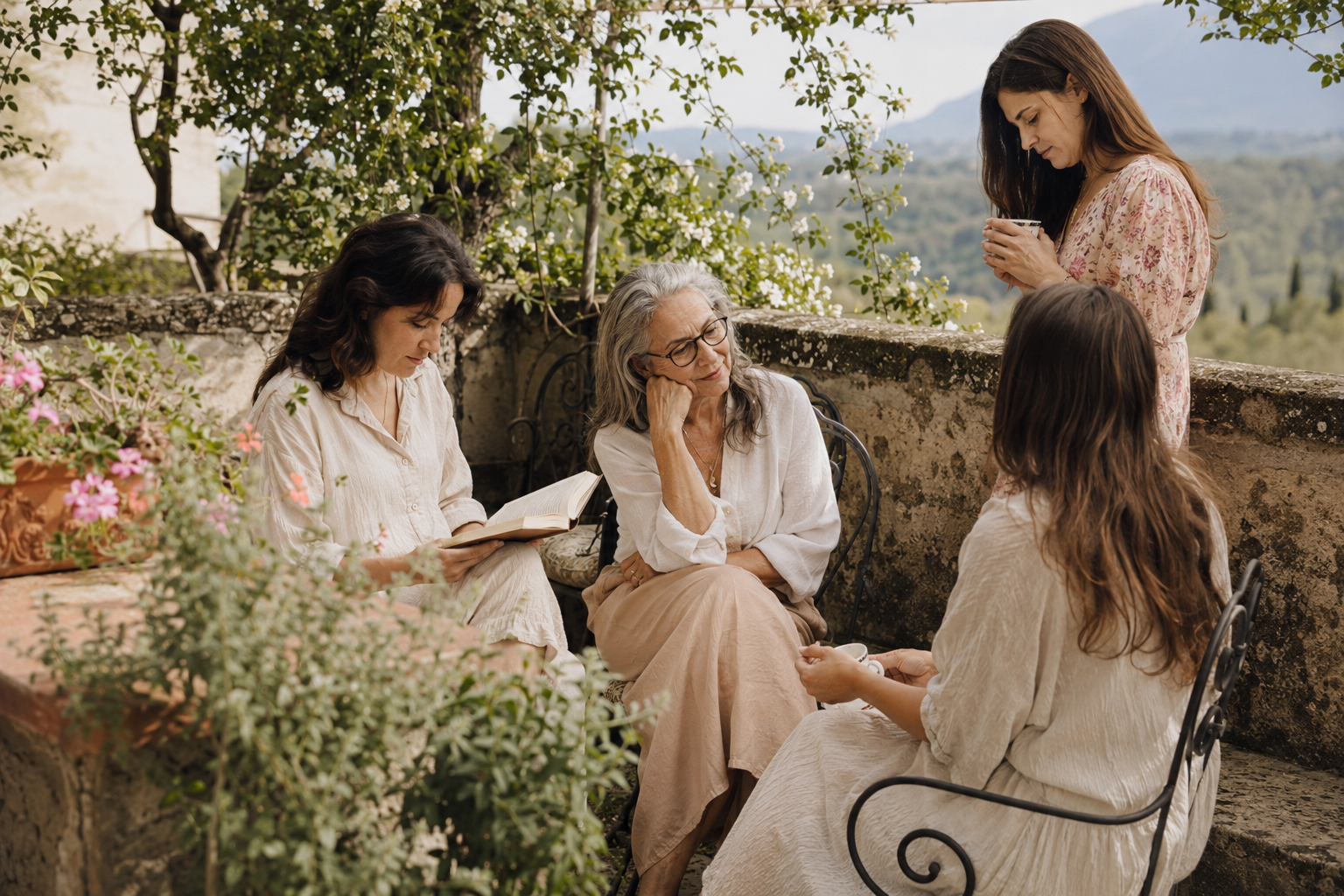
FOUR WOMEN WHO DID NOT GO LOOKING TO BE HEALED
In 1922, Elizabeth von Arnim published a novel called The Enchanted April. Two Englishwomen who barely know each other, Lotty Wilkins and Rose Arbuthnot, see an advertisement for a medieval Italian castle available for the month of April. To afford it, they advertise for two more women. They are joined by Mrs. Fisher, an elderly widow living almost entirely in the past, and Lady Caroline, a young woman worn thin by being endlessly admired and never once known.
Not one of them goes to Italy for healing. They go because they are depleted. And what happens there is slower and stranger than any breakthrough. Nobody teaches them anything. Nobody fixes their circumstances. The place itself begins to do the work, and in that space, what their bodies had been carrying finally has room to surface.
Lotty discovers that her tiredness was the cost of years spent making herself smaller than she was. When she finally has nothing to shrink for, the first thing she feels is guilt for enjoying herself, which is exactly what you would expect from a woman never permitted to simply exist for her own sake.
Rose discovers that she had confused being unseen with being holy. She had loved faithfully in a direction that was not returned and told herself faithfulness alone should be enough, and had never once asked what she actually needed, because asking felt like a failure of devotion.
Mrs. Fisher discovers that living inside memory was not loyalty to the past. It was grief that had never been allowed to be called grief.
And Lady Caroline discovers the hardest thing of all. She hates being looked at the way men look at her, and yet she keeps conducting herself in the very way that guarantees it. The honest answer underneath is that attention had become the closest thing to love she knew how to receive, so she kept performing the version of herself that secured it, even as it emptied her further. Her exhaustion was never social fatigue. It was the ache of being wanted constantly and known by no one.
This is what I want you to notice. None of these women arrived saying, I am exhausted because of something unresolved in my spirit or my story. They arrived saying, I am simply tired. But exhaustion that deep is rarely only about the body. It is often the last honest place left, still trying to get your attention after you have talked yourself out of listening anywhere else.
THE HYMN WRITTEN FROM AN EMPTIED PAIR OF ARMS
Fanny Crosby lost her sight at about six weeks old after a doctor misapplied a treatment for an eye infection. Her father died before her first birthday. She was raised blind and fatherless by her mother and grandmother, in a home that had already absorbed one loss before she could form a memory.
Later she married a fellow teacher, Alexander, also blind. They had one daughter. That daughter died in infancy. Fanny rarely spoke of it. It was, by every account, the loss she carried most privately for the rest of her ninety-four years.
And it was out of that grief, not her blindness, that one of her most beloved hymns was born. Safe in the arms of Jesus. Written by a woman whose own arms had been emptied of the only child she would ever hold.
She did not write about safety after her losses resolved. Her sight never returned. Her daughter never came back. She wrote thousands of hymns about being held while the wounds stayed open, which is a very different thing from pretending they had closed.
SHELTER IS NOT THE SAME AS RESCUE
“He who dwells in the shelter of the Most High will abide in the shadow of the Almighty. I will say to the LORD, ‘My refuge and my fortress, my God, in whom I trust.’” (Psalm 91:1-2, NASB95)
Dwell. Abide. Shelter. These are unhurried words. They ask nothing of you except that you stay somewhere long enough to be covered. And for a woman whose body has learned that staying still is when everything catches up, that is one of the more demanding invitations in Scripture, not one of the easiest.
“He will cover you with His pinions, and under His wings you may seek refuge; His faithfulness is a shield and bulwark.” (Psalm 91:4, NASB95)
Read that carefully. The psalm does not promise the danger disappears. It promises there is a place to seek refuge inside of it. The pinions do not remove the storm. They cover you in it. That distinction matters enormously for anyone who has been told that enough faith would have made the hard thing go away by now.
The Psalms are consistently more honest about this than we are. They hold protection and unresolved suffering in the same breath, without apology, and without rushing the sufferer toward a conclusion. Lament is not the detour on the way to trust. It is often the road.

WHAT I LEARNED ON AN EMPTY APARTMENT FLOOR
I once went on a spiritual direction retreat that was, by any honest measure, a difficult and unbeautiful experience. I sat in silence and solitude and felt like it was punishment. I listened to other women describe tender encounters with the Lord and thought, this is not working for me. I was angry at God, over what felt like a lack of protection for me as a child and a lack of protection for my children now.
That is where I first felt the Lord tell me to move out of a home that had become oppressive to me. Not a confirmation of something I already wanted. I had tried to move three times before and it had collapsed every time. So I laid out the conditions honestly, the way you might negotiate with someone you were not sure you could trust. Steady enough income. A home with a dining room, because six children cannot be homeschooled around a kitchen table forever. And every one of my children saying yes, not merely tolerating it.
Within three weeks, all of them said yes. We found the apartment. We were in it six weeks after that retreat.
The first night, I did not have a bed. I slept on the couch in a mostly empty room surrounded by boxes I had not touched. And I remember the breath. Not a metaphor. An actual, physical, deep breath, the kind that reaches all the way down, the kind I could not remember taking in the house I had just left. I prayed Psalm 91 that night, the same psalm that had felt like an accusation six weeks earlier, and this time I prayed it in faith.
Nothing had been resolved. My children still did not have the protection I wished I could have given them. I still did not have the protection I never received. What changed was that I finally had somewhere to be that was not asking anything of me.
YOU DO NOT HAVE TO BE HEALED FIRST
Nobody fixed those four women in Italy. Nobody restored Fanny Crosby's sight or gave her daughter back. Nobody resolved what I was still angry about that night on the couch.
Safety was never the absence of the wound. It was the presence of shelter, while the wound stayed exactly what it was.
If your body is telling you it is far more tired than your circumstances account for, I would ask you to take that seriously. Not as a failure of faith. As information. And if the place you are dwelling, whether that is a house, a relationship, a church, or simply a way of surviving, is costing you more than you have been letting yourself admit, you are allowed to look for shelter before you have the whole thing figured out.
An Invitation
If something in this found you, the free workbook What Are You Really Feeling? is a slow, guided place to begin naming what has been underneath the tiredness. And if you are ready for companionship rather than another resource to work through alone, Storyline: Seen, Known & Restored is a nine week group experience for women doing exactly this work together, at betweengriefandglory.com/storyline.
You are not behind. You are looking for somewhere to put something you have carried a long time. That is not weakness. That is the beginning of dwelling.
COMPANION DEVOTIONAL
Dwell. Abide. Shelter. These are unhurried words. They ask nothing of you except that you stay somewhere long enough to be covered.
And yet, if you have spent years learning that stopping is when everything catches up, that invitation may be the hardest one in Scripture rather than the easiest. When the noise stops, the grief you never had room for arrives. So we keep moving. Not because we lack faith, but because a body protects what it does not believe can be survived.
Fanny Crosby wrote about being safe in the arms of Jesus after burying the only child she would ever hold, and she never once got her sight back. She was not pretending the losses had closed. She had found a place to abide while they stayed open.
The psalm does not say the danger disappears. It says His pinions cover you inside of it.
You do not have to be healed before you are allowed to look for shelter. You are allowed to stop, and let what has been carried a long time finally have somewhere to be set down.
Subscribe to Notes from the In Between
A quiet place for the long middle.
Short reflections, prayers, and healing words for those living between grief and glory.

For the woman in the middle of something hard.
Lament & Light is a podcast for the Christian woman who is still believing, still showing up, and still carrying more than anyone around her knows. Honest faith. Unhurried conversations. No platitudes.
Author

Paris Byrum
Author
Paris Byrum is a spiritual mentor and trauma-informed soul care guide who helps weary hearts heal through biblical wisdom, sacred presence, and soul-deep formation.
Recent Posts