
El Roi: The God Who Sees the Unseen Grief

Hagar was alone in the wilderness when she named God.
Not Abraham. Not Sarah. Not one of the patriarchs whose names we know from a hundred sermons. Hagar, a servant, pregnant and then pushed out, sitting by a spring in the desert with nothing and no one, is the one who looks at God and gives Him a name that no one else in Scripture uses first. El Roi. The God who sees.
She did not name Him that because someone explained His character to her in a teaching series. She named Him that because, in the middle of being unseen by everyone else in her life, she discovered that God had seen her the entire time. Not from a distance. Not in the abstract. He saw her specifically, in her specific wilderness, and He told her so.
That is where this week's episode of A Summer of Sorrows lives, and it is where this post lives too.
Want to listen instead of read?
THE DIFFERENCE BETWEEN ATTENDED TO AND WITNESSED
There is a difference between being attended to and being witnessed, and most of us have experienced the first far more often than the second.
Being attended to is when someone notices you are struggling and responds with the things people are trained to offer. A verse. A reframe. A suggestion. Sometimes even a genuinely kind word. It is not nothing. But it is also, often, a way of moving past the moment rather than staying inside it. Attending to someone's pain can be, without anyone intending it, a way of managing it so that it does not have to be fully felt by either person.
Being witnessed is different. To be witnessed is to have someone stay with you inside the thing, without trying to change its shape. Not because they do not care enough to help. Because they understand, even if only instinctively, that some things cannot be helped in the moment they are happening. They can only be accompanied.
"My God, my God, why have You forsaken me?" (Psalm 22:1, NASB95)
This is the cry that opens Psalm 22, the cry David wrote and Jesus prayed from the cross. It is not a question that gets answered in the next verse. It sits there, raw, unattended to, for a long stretch of the psalm. And yet by the time we reach verse twenty-four, something has shifted, not because the suffering ended, but because of what is true about God in the middle of it.
"For He has not despised or scorned the suffering of the afflicted one; He has not hidden His face from him, but has listened to his cry for help." (Psalm 22:24, NASB95)
He has not hidden His face. That is El Roi again. Not a God who fixes the wilderness from a distance, but a God whose face is turned toward the person in it.
PERPETUA, WRITING FROM INSIDE THE WALL
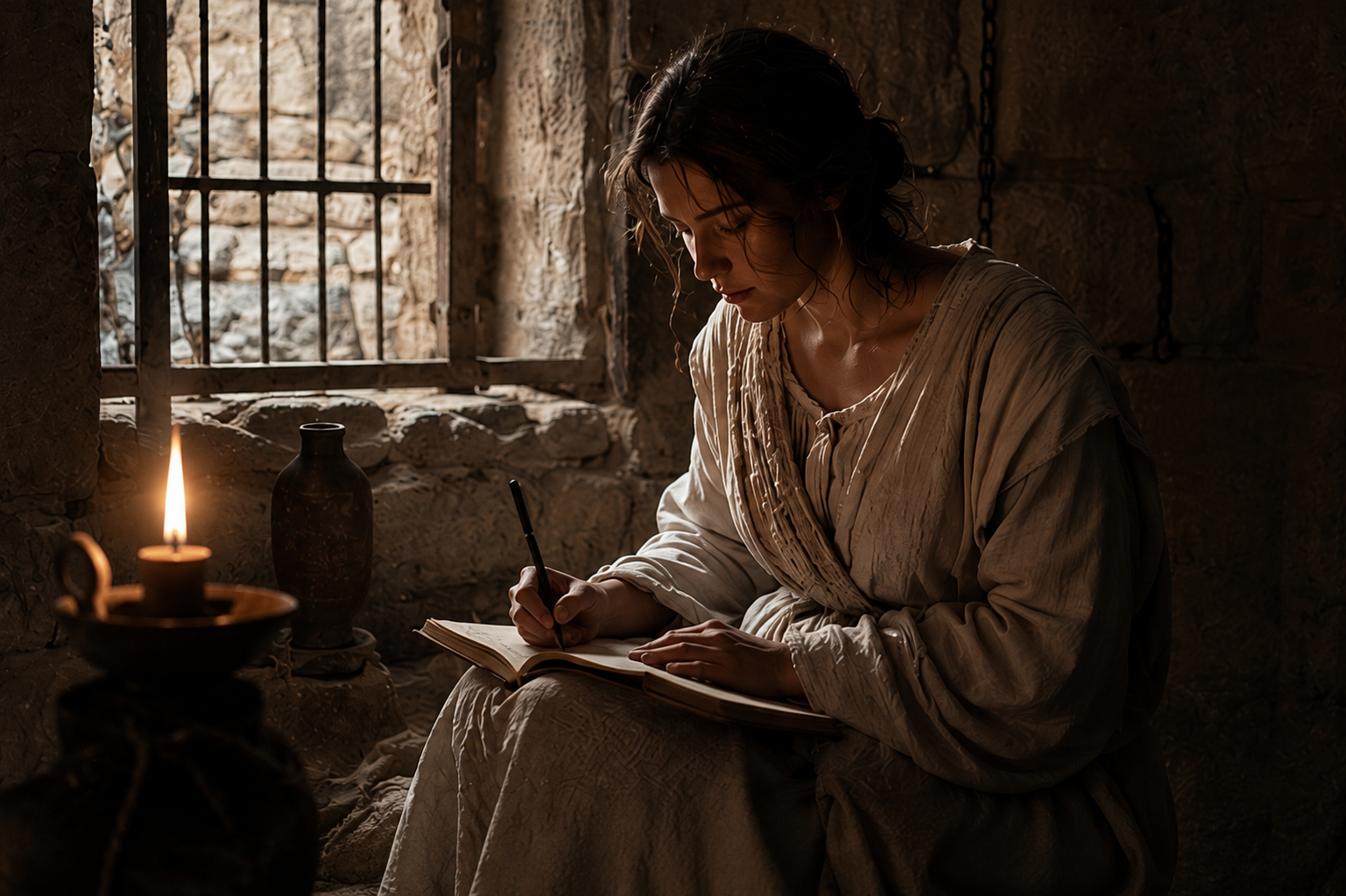
In the year 203, a young woman named Perpetua was imprisoned for her faith in Carthage. She was not yet thirty. She had an infant son. And while she waited in prison for what would become her martyrdom, she wrote down her own account of what was happening to her, in her own words, which makes her one of the earliest women whose voice we still have in the historical record of the early church.
What strikes me most about Perpetua's account is not the courage, though there is plenty of it. It is the specificity. She describes the heat of the prison, the crowding, her fear for her child, her father's pleading, the visions she had in the night. She does not write a polished martyrdom narrative handed to her by someone else. She writes from inside it, while she is still inside it, the way a person writes when they believe what is happening to them matters enough to be recorded honestly.
Perpetua was, in a sense, doing for herself what Hagar discovered God had already done for her. She was witnessing her own suffering instead of waiting for someone else to decide whether it was worth witnessing. And in doing so, she left behind something that has outlasted the prison, the persecution, and the empire that built it. A record that says, in essence: this happened to me, and it was real, and I am telling you about it because it matters.
WHAT IT FELT LIKE TO BE WITNESSED WITHOUT WORDS
I think often about a particular afternoon during one of the hardest seasons I have walked through. A friend came to sit with me. She did not bring a plan. She did not bring Scripture verses meant to redirect my thinking. She opened the curtains in the room where I had been lying for what felt like days, and she pulled a chair up beside the bed, and when she heard me crying, she read a passage of Scripture into the quiet. Not as an answer. As a kind of company.
She did not say it would be okay. She did not ask me what I was learning. She just stayed, the way Job's friends stayed for seven days before they made the mistake of trying to explain his suffering to him.
I have come to believe that what she did that afternoon was a small, human echo of what Hagar discovered in the wilderness. El Roi did not appear to Hagar with an explanation for why her circumstances had unfolded the way they had. He appeared to her, found her, by the spring, in her specific place, and let her know that she had been seen the entire time, even when it did not feel that way.
YOU HAVE BEEN ATTENDED TO. BUT HAVE YOU BEEN WITNESSED?
If you have spent a long season in a hard place, there is a good chance people have attended to you. They have sent the verse, offered the advice, told you they were praying. And none of that is meaningless. But I wonder if, underneath all of it, there is a quieter question you have been carrying. Has anyone actually seen this? Not the version of it I can explain in a sentence when someone asks how I am doing. The actual weight of it. The thing I have not found words for yet.
El Roi already knows the answer. He has not hidden His face from you, not in the parts of this you can articulate and not in the parts you cannot. He saw Hagar in a wilderness she did not choose, gave her water she did not expect, and let her know that the seeing had been happening long before she noticed it.
You have been seen, even in the part of this you have not said out loud yet.
WHERE WE GO FROM HERE
Next week, this series turns to the question of companions, the ones we are given in a hard season that we did not choose and would not have picked for ourselves, and what they are doing in us even when we cannot tell yet. But for this week, I want to leave you with just this.
You are not waiting to be noticed. You already have been. El Roi has not turned His face away, not for one day of this, not for one hour. And if you have a friend, or a memory of a friend, who once sat with you the way mine did, who opened the curtains and did not need to say anything, that too was Him. He sends witnesses. Sometimes through Scripture. Sometimes through a person who pulls up a chair.
One more thing before I go.
In a couple of weeks, on July 8 and 9, I am hosting Seen in the Wilderness, a two day live experience, free, online. If El Roi, the God who sees, is something you want to sit with longer than one email or one episode, this was built for exactly that. The details are still coming together, but if you want to be the first to know when registration opens, you can join the waitlist here.
Join the Seen in the Wilderness waitlist
Subscribe to Notes from the In Between
A quiet place for the long middle.
Short reflections, prayers, and healing words for those living between grief and glory.

For the woman in the middle of something hard.
Lament & Light is a podcast for the Christian woman who is still believing, still showing up, and still carrying more than anyone around her knows. Honest faith. Unhurried conversations. No platitudes.
Author

Paris Byrum
Author
Paris Byrum is a spiritual mentor and trauma-informed soul care guide who helps weary hearts heal through biblical wisdom, sacred presence, and soul-deep formation.
Recent Posts