
When Faith Stops Working — The Christian Dark Night of the Soul

When Faith Stops Working the Way It Used To
— ✦ —
There is a particular kind of exhaustion that does not have a name in most Christian circles.
It is not burnout, exactly — though exhaustion is part of it. It is not depression, though the weight of it can feel indistinguishable. It is not a crisis of belief, though you may have begun to wonder if that is what it is.
It is the experience of waking up one day and realizing that faith — the faith you have practiced, built, tended, and sometimes fought for — has stopped producing what it once did.
Want to listen instead of read?
Prayer feels hollow. Scripture feels distant. Worship feels like going through motions you no longer understand. And God, who once felt present and close, now feels somewhere behind a door that will not open no matter how many times you knock.
If you have found your way to this page, you may be living in that space right now. Or you may be watching someone you love live there. Or you may have been there once and are only now finding language for what you survived.
Whatever brought you here — you are in the right place.
Because what you are experiencing has a name. And it is not failure.
— ✦ —
When the Map Stops Corresponding to the Territory
Most of us come to faith with a map. It may have come from a church, a mentor, a family, a tradition. The map looks different for different people, but it tends to contain the same basic elements: read your Bible, pray, attend church, serve, give, grow. Do these things faithfully and your faith will deepen. Your relationship with God will strengthen. Your life will begin to reflect the fruit of the Spirit.
And for a season, that map works. Genuinely. The structure it provides is not a small thing — it gives form to devotion, community to the solitary, language to the inarticulate longings of a new or growing faith. It is real. It is good.
But at some point — and this point arrives for many serious, committed, faithful followers of Christ — the map stops corresponding to the territory.
You do what the map says. And nothing happens. Or worse — something happens, but it is not what you expected. Confusion where there used to be clarity. Silence where there used to be a sense of presence. A flatness that no amount of effort or obedience seems to resolve.
And the cruelest part is what the church often says at this point:
- Try harder.
- Pray more.
- Get back to the fundamentals of the faith.
- Press on towards the prize.
As if the map were fine and you simply were not reading it correctly.
"Even though I walk through the valley of the shadow of death, I will fear no evil, for You are with me; Your rod and Your staff, they comfort me." — Psalm 23:4, NASB95
The shepherd psalm does not skip the valley. It does not promise an alternate route. It promises a companion through it. And that distinction — through, not around — changes everything about what it means to stay.

What Nobody Told You About the Middle of the Journey
There is a concept that the contemplative Christian tradition has known about for centuries — and that the modern evangelical church has largely forgotten to pass on.
It is called the wall.
The wall is not a crisis of belief, though it may certainly feel like it. It is a transition season — a place in the journey of faith that many committed followers of Christ pass through, usually somewhere in the middle of their walk, where the spirituality of the first half of life stops being sufficient for what life is now asking of them.
It tends to arrive in the wake of suffering. A marriage that fractures. A church that wounds. A loss that does not resolve. A body that breaks. A season of injustice that will not end. Or sometimes — and this is the most disorienting version — it arrives without any obvious cause at all. Just a slow withdrawal of the felt sense of God's presence, stretching on and on, while you keep showing up and nothing comes back.
When faith stops working the way it used to, this is often what is happening. Not a failure of faith. A transition in faith. A movement — painful, disorienting, and largely undiscussed — from one kind of relationship with God into another.
What the Mystics Knew That the Modern Church Forgot
St. John of the Cross, the sixteenth-century Spanish mystic, called it the dark night of the soul. He wrote about it not as a metaphor but as a lived experience — a season of spiritual dryness and darkness that is not evidence of God's absence but of a different kind of presence. A deeper invitation. A purification that cannot happen in the light.
He had been there. He wrote it down so that others, centuries later, could find it and know: this has a name. This is ancient territory. You are not the first.
"My soul waits in silence for God only; from Him is my salvation. He only is my rock and my salvation, my stronghold; I shall not be greatly shaken." — Psalm 62:1–2, NASB95
Not a little shaken. Greatly shaken. The psalmist does not pretend the shaking is not happening. He names it — and then names the one thing that holds. Not the program. Not the certainty. Not the feeling. God only.
The Six Faces of the Wall — And Why Naming Yours Matters
The wall is not a single experience. It comes in different forms, and naming which form you are in matters — because each one carries its own path, its own particular graces and hindrances, its own way through.
If you misname the wall, you will reach for the wrong medicine. You will try to pray your way through what actually requires rest. You will try to rest your way through what actually requires repentance. You will assume God is absent when, in reality, He is meeting you in a way you do not yet recognize.
Naming the wall is not about control. It is about honesty. And honesty is what allows grace to land where it is actually needed.
Burnout
Exhaustion from overworking — in a job, a ministry, a season of life that demanded more than you had.
This kind of wall is often the most straightforward, and yet the most ignored. Because it can feel “less spiritual,” people push past it, spiritualize it, or shame themselves for it. But burnout is not primarily a spiritual failure — it is a human limitation being violated over time.
Your body has kept the score. Your mind is tired in a way that sleep alone does not fix. Even your prayer life can feel thin, not because God has withdrawn, but because you are depleted.
It is real and it is serious. And it responds, eventually, to rest — not just a day off, but an actual reordering of limits. This wall does not yield to striving. It yields to stopping.
Spiritual Burnout
This is what happens when service to God becomes compulsive — when compassion fatigue sets in, when you have poured out for others so long that your own interior life has gone dry.
From the outside, it often looks like faithfulness. You are still showing up. Still serving. Still saying the right things. But internally, something has thinned. Prayer feels like effort. Scripture feels distant. You are giving God to others in ways you are no longer receiving Him yourself.
Many faithful women in the church hit this wall quietly, without anyone noticing, until they simply disappear — not always physically, but internally. They disengage. They numb. Or they continue on, but without life.
This wall is not solved by doing more “spiritual things.” It is addressed by returning to God without an assignment. Learning again how to be with Him, not just be useful to Him.
Blowout
The wall that arrives through moral failing — a fracture in your own integrity, or someone else's, that shatters the ground you were standing on.
This is the wall that destabilizes identity. The story you believed about yourself — or about someone you trusted — no longer holds. There is rupture. Exposure. Often, a sense that everything has been contaminated by what happened.
It carries the heaviest shame because it feels personal. Chosen. Preventable. And so the instinct is to fix it quickly — to confess, to repent, to move on, to prove that you are not “that person.”
But that instinct, while understandable, is incomplete. Because this wall is not just about forgiveness — it is about healing the parts of you that allowed the fracture, or that were wounded by it.
And, over time, if you stay in that work, something else begins to surface. The categories you once used so easily — who is “faithful,” who is “compromised,” who is “safe,” who is “not” — begin to lose their sharpness. Not because truth no longer matters, but because you have come into contact with your own capacity for failure and sin.
What once lived as quiet judgment, or subtle religiosity, is exposed for what it is: distance from His mercy. And not in a way that crushes you, but in a way that levels you.
There is a path through. But it is not faster repentance. It is the slow, humbling work of the Lord's mercy and grace actually received — not just believed in theory, but allowed to reach the places you would rather keep hidden. And, in time, it becomes the kind of mercy and grace you extend differently to others.
Personal Crisis
The wall that arrives through circumstances: grief, illness, divorce, death, financial collapse, family dissension.
This is the wall where life itself becomes heavy in a way that reorganizes everything. The structures that once held you up no longer hold. Your capacity shrinks. Things that once felt manageable now feel impossible.
Often, there is a quiet confusion underneath it: I thought my faith would carry me better than this. And when it doesn’t, people assume something is wrong with them.
But this wall is not a failure of faith. It is an encounter with limits — the kind that no amount of preparation fully prevents.
"Arise and eat, for the journey is too great for you." — 1 Kings 19:7, NASB95
God did not rebuke Elijah under the broom tree. He did not correct his theology or demand resilience. He sent bread. Rest. Then gentle presence.
That is how He meets His people in personal crisis — not with a program, but with nourishment and accompaniment. Not all at once. Just enough for the next step.
Faith Crisis
The wall of disbelief — when the questions grow louder than the answers, when cynicism begins to rise, when you sit in a church service and nothing lands.
This wall is unsettling because it does not stay contained. It begins to touch everything — Scripture, prayer, community, even your sense of who God is. What once felt certain now feels unstable, or distant, or hollow.
And because of that, many people feel pressure to resolve it quickly. To find the right answer, the right book, the right argument that will restore what was lost.
But this wall is not always resolved through clarity. Sometimes it is endured through honesty.
It is terrifying because it threatens the foundation itself. But it is also ancient. The psalmists lived in it. Thomas the Apostle lived in it.
You are not the first to sit with a faith that feels like it is coming apart.
And this wall, too, has a way through — not by forcing certainty, but by remaining present, even when certainty does not return on your timeline.
The Dark Night of the Soul
The sixth wall, and the most misunderstood: ongoing spiritual dryness without obvious cause. Prayer that feels like speaking into an abyss. Worship that produces nothing. A silence that does not lift no matter what you do.
This is not burnout. It does not respond to rest. It is a different kind of wall entirely — one that the contemplative tradition describes not as punishment but as purification. God withdrawing comfort, not relationship. Leading you, in the darkness, toward a faith that is no longer tethered to feeling.
"In the same way the Spirit also helps our weakness; for we do not know how to pray as we should, but the Spirit Himself intercedes for us with groanings too deep for words." — Romans 8:26, NASB95
The Spirit prays when you cannot. He groans on your behalf when you have run out of language. You do not have to produce something coherent for God in this season. He already knows. And He has not left.

The Fork in the Road — and the Third Way Through
When faith stops working the way it used to, most people face one of three responses.
The first is to perform harder — to double down on the disciplines, press through the dryness, keep doing what the map says even when the territory no longer matches. This response is understandable, and for a season it may sustain you. But over time it tends toward one of two destinations: a faith maintained entirely on the surface while the interior goes increasingly dark, or a collapse into exhaustion that looks, from the outside, like losing faith entirely.
The second response is to walk away — to conclude that faith itself has failed, that the whole project was built on something that does not hold, and to begin the work of deconstruction. This response is also understandable. When the map has stopped corresponding to the territory for long enough, abandoning it begins to feel like the only honest option.
But there is a third way.
It is the way the mystics took. The way the desert fathers took. The way the psalmists took — not when they arrived at easy answers, but when they kept bringing their unanswered questions to God anyway, and stayed.
The third way is to pass through the wall. Not to escape it, not to perform your way past it, but to go through it — with honesty, with companionship, with the ancient wisdom of people who have walked this territory before you.
"For we do not want you to be unaware, brethren, of our affliction which came to us in Asia, that we were burdened excessively, beyond our strength, so that we despaired even of life; indeed, we had the sentence of death within ourselves so that we would not trust in ourselves, but in God who raises the dead." — 2 Corinthians 1:8–9, NASB95
Paul did not hide the depth of what he had endured. He wrote it down. He shared it with the church — not to perform his vulnerability, but because he understood that the purpose of surviving something is to offer what you learned to the people who come after you.
That is what the third way requires. Not a hero's resolve. A survivor's honesty, and the willingness to receive what God is offering in the dark.
You Are Not Losing Your Faith — It Is Going Deeper
I want to say this plainly, because I think it is what you most need to hear if you are in this season:
What you are experiencing is not evidence that your faith is weak. It may be evidence that it is being deepened.
The wall is not the end of the journey. It is — for many faithful Christians — the place where the journey becomes most real. Where faith stops being a performance and starts being a relationship. Where the certainties you were given make room for something more durable: a trust that has been tested by silence and has not collapsed.
"But we all, with unveiled face, beholding as in a mirror the glory of the Lord, are being transformed into the same image from glory to glory, just as from the Lord, the Spirit." — 2 Corinthians 3:18, NASB95
Glory to glory. Not from glory to suffering. But through suffering, into deeper glory. The transformation is happening. Even when you cannot see it. Even when it feels like nothing is happening at all.
You are not behind. You are not failing.
You may simply be further along the road than the map you were given was designed to take you.
— ✦ —
A Place to Exhale
If this has named something real for you — if you have been carrying the weight of a faith that has stopped working and not known what to call it — I want you to know that you do not have to carry it alone.
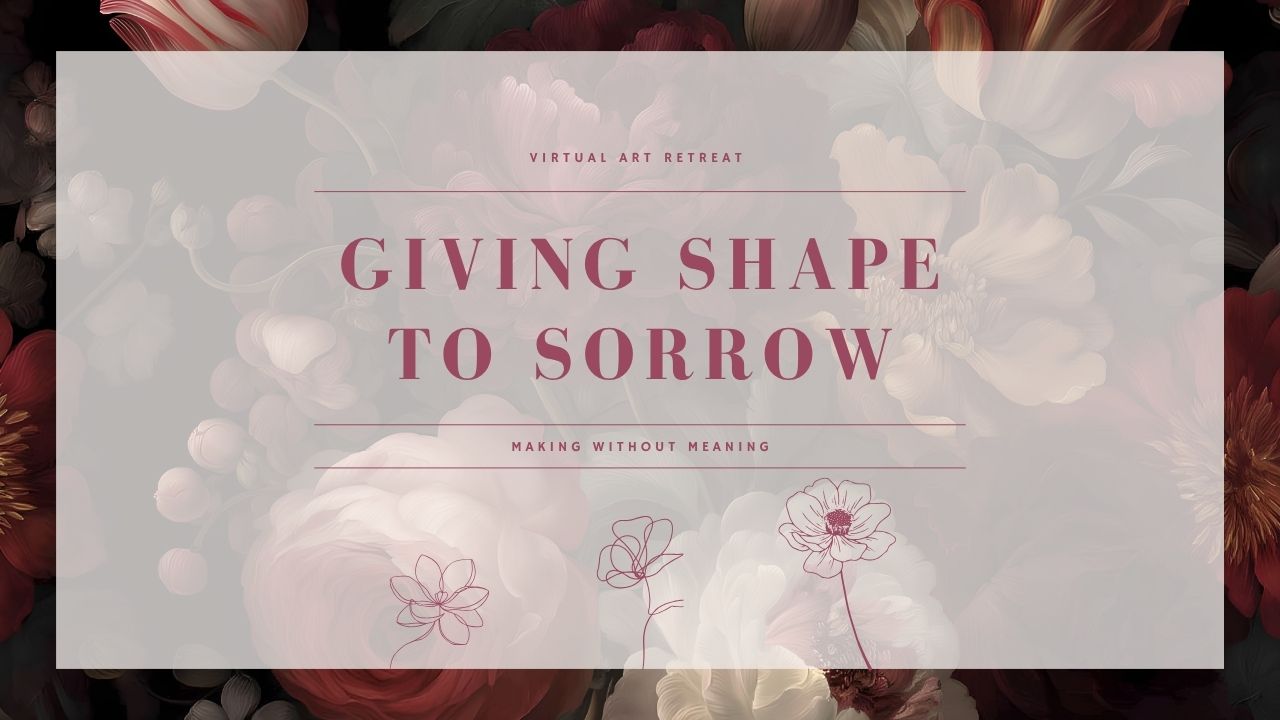
On June 13, I am holding a 90-minute online retreat called Giving Shape to Sorrow. It is a guided grief art retreat — and before you close the door on the word art, hear what it actually is.
This is not an art class. No skill is required. No experience. Nothing elaborate. It is simple mark-making and watercolor — your hand moving across a page in response to Scripture and silence. Nothing needs to make sense. Nothing needs to be beautiful. The supplies are things you likely already have at home.
It is 90 minutes of space to be with God without striving, fixing, or explaining. Cameras optional. Sharing optional. You can come exactly as you are — in whatever state your faith is in right now.
I created this for the woman who is at the wall. Who needs somewhere to exhale. Who does not have words for what she is carrying and does not need to find them. Who just needs to show up and let God meet her there.
The retreat is Saturday, June 13. Registration is open now.
Come exactly as you are. You are welcome here.
— ✦ —
Subscribe to Notes from the In Between
A quiet place for the long middle.
Short reflections, prayers, and healing words for those living between grief and glory.

For the woman in the middle of something hard.
Lament & Light is a podcast for the Christian woman who is still believing, still showing up, and still carrying more than anyone around her knows. Honest faith. Unhurried conversations. No platitudes.
Author

Paris Byrum
Author
Paris Byrum is a spiritual mentor and trauma-informed soul care guide who helps weary hearts heal through biblical wisdom, sacred presence, and soul-deep formation.
Recent Posts