
Six Types of Walls — Burnout vs Dark Night of the Soul
Six Types of Walls — And Why It Matters Which One You're In
— ✦ —
Not all darkness is the same.
And one of the most disorienting — and quietly harmful — things that happens when faith stops working is that we apply the wrong remedy. We treat a dark night of the soul like burnout, and wonder why rest is not helping. We treat a faith crisis like a personal crisis, and wonder why our circumstances improving does not make the questions go away. We treat a blowout like spiritual dryness, and wonder why discipline is making things worse.
The wall has different faces. And knowing which face you are looking at is the beginning of knowing how to stay.
Want to listen instead of read?
This post is a companion to Episode 2 of the Through the Wall podcast series. If you have not yet listened, you are welcome to start there — or to begin here, and let this be your map.
— ✦ —
Why Finding Your Location Changes Everything
When you are at the wall — when faith feels dry, distant, or broken — the instinct is to work harder at the things that used to work. More prayer. More reading. More effort. More discipline. The assumption is that the problem is a deficiency in effort, and the solution is more of the same.
But what if the problem is not effort at all? What if the remedy is not more of what worked before — because what you are in requires something different entirely?
There is a framework that has been deeply formative for me, drawn from the work of Janet Hagberg, Robert Guelich, and the Soul Shepherding Institute: the idea that the wall is not a single experience but a transition season that comes in six distinct forms, each with its own texture, its own path, and its own particular grace.
As you read through these, I invite you to sit with the one that resonates. You may find more than one. You may find that they have come in sequence — one giving way to another over months or years. What matters is that you begin to have language for what you are carrying.
"My God, my God, why have You forsaken me? Far from my deliverance are the words of my groaning." — Psalm 22:1, NASB95
The psalmist did not arrive at this cry from nowhere. He named his location precisely. And in the naming — in the honest, unperformed articulation of where he was — he found the ground to pray from. That is what naming your wall can do for you.
— ✦ —

The Six Walls — A Felt Guide to Finding Yourself
The First Wall — Burnout: When You Have Given More Than You Had
Burnout is the exhaustion that comes from overextending across a sustained season. It is not weakness. It is what happens when a person of genuine commitment and genuine love keeps giving past empty — in a job, a ministry, a caregiving role, a season of life that simply asked too much for too long.
Burnout feels like flatness. A loss of motivation that once came naturally. A disconnection from things that used to energize. The sense that you are going through the motions of your life without being fully present in it. Spiritually, it can look like a loss of enthusiasm for practices that once nourished — but not because those practices have stopped being true. Because your capacity to receive has been depleted.
The path through burnout, when it is genuinely burnout, involves rest. Margin. Permission to stop. Withdrawal from the demands that created the depletion. And slowly — over time, not overnight — restoration. The return of appetite. The return of energy. The return of desire.
If rest helps, it was burnout. That is important information.
"Arise and eat, for the journey is too great for you." — 1 Kings 19:7, NASB95
God's response to Elijah under the broom tree was not a rebuke or a program. It was bread, water, and the acknowledgment that the journey itself had been too great. He met exhaustion with nourishment. That is still how He tends to meet burnout.
The Second Wall — Spiritual Burnout: When Serving God Has Emptied You
Spiritual burnout is a specific and often overlooked form of depletion — and it is different from general burnout in ways that matter.
Spiritual burnout is what happens when service to God becomes compulsive. When you cannot stop helping, fixing, serving, leading, even as your interior life empties out. When the activity of faith has become so central that the relationship underneath it has quietly gone dry. Compassion fatigue. The weight of holding other people's pain while your own goes unattended. The exhaustion of always being the one who holds — and rarely being held.
Many women in the church hit this wall in silence. They are the steady ones. The reliable ones. The ones who show up every week and never seem to need anything. And then one day they simply stop showing up — and nobody quite knows why.
If this resonates, I want to say something directly: you are allowed to need. You are allowed to receive. The same God who sent you to serve others has not exempted you from the care He asks us to extend to one another. Receiving is not weakness. It may be the most faithful thing available to you in this season.
The Third Wall — Blowout: When Something Broke
A blowout is a moral failing — your own, or someone else's directed at you — that shatters the ground you were standing on.
Blowouts often carry the heaviest shame, because the first half of faith tends to teach us that this kind of thing is not supposed to happen to people who are serious about God. "Serious people do not fall this way. Serious people do not get failed this way by someone they trusted." And so the shame of the blowout is compounded by the theological framework that says: this should not have happened.
But blowouts do happen. To serious people. To faithful people. To people who love God and have spent years trying to walk with integrity.
The path through a blowout is not faster repentance or harder discipline. It is mercy. Actually received, not just theologically affirmed. The slow, humbling work of allowing grace to reach the part of you that has been most exposed — and learning, again, that God's love is not conditional on your performance.
"The steadfast love of the Lord never ceases; His mercies never come to an end; they are new every morning; great is Your faithfulness." — Lamentations 3:22–23, NASB95
Jeremiah did not write these words from a place of resolution. He wrote them from inside destruction. And they are still true from the rubble.
The Fourth Wall — Personal Crisis: When Life Itself Is Too Heavy
The wall of personal crisis arrives through circumstance. Illness. Grief. Divorce. Death. Depression. Financial collapse. The weight of life arriving in a season with more force than your faith was built to hold.
Personal crises are not spiritual failures. They are human realities. And the God who is present in them is not standing at a distance, watching to see how well you cope.
"The Lord is near to the brokenhearted and saves those who are crushed in spirit." — Psalm 34:18, NASB95
Personal crisis can shade into other kinds of walls — faith crisis, dark night — especially when it is prolonged. When the circumstances do not resolve and the unanswered prayers accumulate, the personal crisis can become a crisis of trust. That progression is not a failure. It is a sign that you are taking seriously what your life is asking of you.
In personal crisis, the most important thing is not to be alone in it. Not to find answers. Not to resolve the unanswerable. But to be accompanied — by people who will sit with you without flinching, and by a God whose presence does not require that you have it together before He draws near.
The Fifth Wall — Faith Crisis: When the Questions Become Louder Than the Answers
A faith crisis is when disbelief creeps in. When cynicism rises. When the theological answers you were given stop being sufficient for the questions your life is generating. When you sit in a church service and nothing lands. When you read Scripture and feel nothing — or feel confused, or angry, or betrayed by what you read.
The faith crisis is ancient territory. The psalmists lived in it. Job lived in it. Habakkuk wrote an entire book from inside it. Thomas, in the upper room after the resurrection, lived in it for a week before Jesus came back for him specifically.
"How long, O Lord? Will You forget me forever? How long will You hide Your face from me?" — Psalm 13:1, NASB95
The faith crisis does not require that you pretend the questions away. It requires that you keep bringing them — however jagged, however angry, however confused — to the God they are addressed to. The psalmists did not resolve their questions before they prayed. They prayed the questions.
The path through a faith crisis is honest wrestling, stayed with rather than fled from. Not forced certainty. Not performed resolution. The willingness to remain in the conversation even when the conversation is hard.
I also want to name something carefully: a faith crisis is not the same as deconstruction, though deconstruction often begins in one. The difference is in direction. A faith crisis asks hard questions while remaining in relationship with God. Deconstruction, at its most honest, is a faith crisis that has been left without accompaniment for too long — and has curdled into a conclusion rather than a question.
If you are in a faith crisis, you do not need someone to defend God to you. You need someone to sit with you in the questions. That is a different kind of companionship — and it is available.
The Sixth Wall — Dark Night of the Soul: When God Goes Quiet and the Silence Stays
The dark night of the soul is the most misunderstood wall of all, and the one the modern church is least equipped to accompany.
It looks, from the outside, like depression. It looks, from the inside, like abandonment. It is neither.
The dark night is ongoing spiritual dryness without obvious cause. Nothing catastrophic has happened. You have not burned out — rest does not touch it. You have not had a moral failing. Your circumstances may even be stable. And yet God feels completely absent. Prayer feels like speaking into an abyss. Worship produces nothing. You keep showing up and the silence persists.
St. John of the Cross, who named and described this experience in the sixteenth century, was clear: the dark night is not God's absence. It is a different kind of presence. A purification. A stripping away of the spiritual consolations you have been relying on — not to take God away, but to take away everything that has been standing between you and God.
"In the same way the Spirit also helps our weakness; for we do not know how to pray as we should, but the Spirit Himself intercedes for us with groanings too deep for words." — Romans 8:26, NASB95
The dark night produces something that no other season of the spiritual life produces in quite the same way: a faith that is no longer dependent on feeling. A trust that is no longer tethered to experience. A love for God that has survived the removal of everything that made loving God feel good — and has found that it is still there.
The Puritan writers observed that the deepest believers often experience the deepest desolation. They did not see this as a sign of weak faith. They saw it, rightly, as maturing faith.
Psalm 88 — the only psalm in all of Scripture that ends in darkness with no resolution — remains, to its last word, addressed to God. Faith can exist without comfort. Prayer can continue in the dark. And the silence is not the last word.
— ✦ —
The Distinction That Changes Everything — Burnout vs. Dark Night
Of all the distinctions in this framework, the one between burnout and the dark night of the soul is the one I most want to press into — because the confusion between them causes real, sustained harm.
Burnout responds to rest. If you step back, take a sabbatical, create margin, say no to the things that have been demanding your energy — burnout will eventually lift. The capacity returns. The motivation comes back. The practices that felt flat begin to nourish again. That is how you know it was burnout.
The dark night does not respond to rest. You can sleep, step back, take months away — and come back to the same hollow silence. The same absence in prayer. The same flatness in worship. Not because you are not trying hard enough. Because you are at a different kind of wall entirely.
When the dark night is treated like burnout — when someone in the deepest spiritual formation of their life is told to rest more and try harder — the result is not healing. It is compounded shame. The sense that even rest is not working, which must mean the problem is something worse than exhaustion.
If rest does not help, it is not burnout. And that is not a sign that something is catastrophically wrong. It is a sign that you need a different kind of guidance for where you are.
"Be still, and know that I am God." — Psalm 46:10, NASB95
The Hebrew behind that verse is stronger than a gentle invitation to quiet. It is closer to: let your hands fall. Stop striving. Stop fighting. The dark night is, among other things, the season where that surrender is learned — not as a concept, but as a lived reality.
— ✦ —
A Simple Self-Assessment — Where Are You Right Now?
Read through these statements slowly. Notice which ones feel true in your current experience with God. You do not need to analyze yourself. Just notice.
- For a while now, I have not been hearing God's voice the way I used to — or sensing the Holy Spirit's promptings the way I once did.
- I feel confused about where I am with God. What used to feel clear now feels uncertain.
- There are moments — sometimes long seasons — where I wonder: does Jesus even love me? Am I even still in the faith?
- I am stuck in my faith walk. Something has stopped moving, and I do not know how to get it moving again.
- The spiritual disciplines that once anchored me — prayer, Scripture, worship, community — no longer seem to reach me the way they did.
- Reading Scripture feels distant, confusing, or even painful right now, rather than nourishing.
- I carry a low-level torment or inner distress that does not seem to lift, no matter how much I pray or seek God.
- Where I once found peace in my relationship with God, I now find mostly chaos, confusion, or a silence I do not know how to interpret.
If several of these feel true — you may be in a transition season at the wall. And if that is where you are, you are in exactly the right place to be having this conversation.
Take a moment with the six wall descriptions above and ask yourself: which one resonates most? Which texture most closely matches what you are carrying? You do not have to be certain. You do not have to fit neatly into one category. But beginning to locate yourself is the beginning of knowing how to stay.
— ✦ —
You Are Not Alone in Your Location
Whatever wall you are at — you are not the first to have been there.
Elijah despaired of his life under a broom tree. Paul wrote that he and his companions had despaired of life itself. Jesus, in the garden of Gethsemane, asked if there was another way — and sweat blood in the asking. John of the Cross wrote his most enduring work from a prison cell barely large enough to stand in. Julian of Norwich received her visions during a near-fatal illness. The Desert Fathers went to the wilderness specifically because they found that God met them in what most people were fleeing.
"Therefore, since we have so great a cloud of witnesses surrounding us, let us also lay aside every encumbrance and the sin which so easily entangles us, and let us run with endurance the race that is set before us." — Hebrews 12:1, NASB95
That cloud is not only the triumphant. It is also the suffering faithful. The ones who despaired and stayed. The ones who wrote from prison and from sickbeds and from wilderness and from the inside of the whale. They are with you. They have been where you are. And they stayed.
You are not crazy.
You are not uniquely broken.
You are not failing.
You are in ancient, holy, hard company. And you are held.
— ✦ —
A Space to Bring What You Are Carrying
Knowing which wall you are at is only the beginning. What you do with that knowledge — how you stay, what practices sustain you, where you find companionship in the dark — is the work of this season.
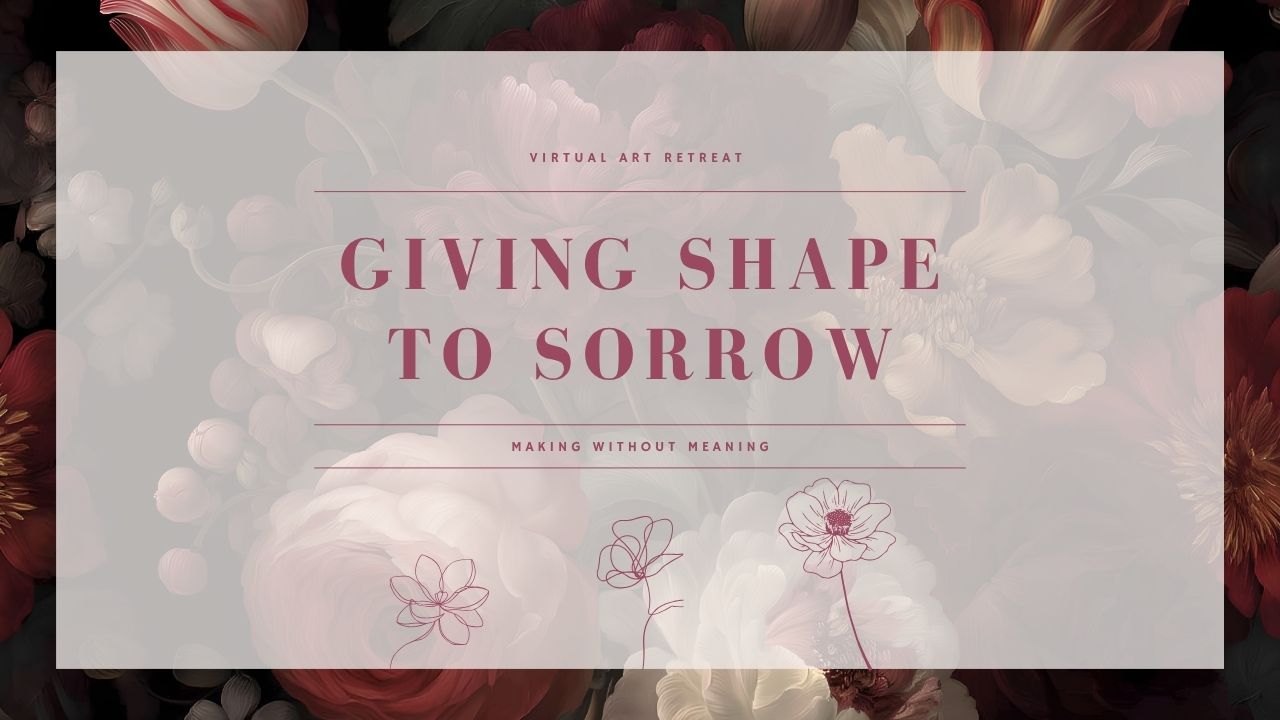
On June 13, I am holding a 90-minute online retreat called Giving Shape to Sorrow. It is for women who are at the wall — in any of its forms — and who need a space to be with God without striving, fixing, or explaining. Simple art as prayer. Scripture and silence. No artistic skill required. No words required. Cameras optional.
You do not need to have your wall named precisely before you come. You do not need to have language for what you are carrying. You just need to show up.
The retreat is Saturday, June 13. Registration is open now.
Come exactly as you are. You are welcome here.
— ✦ —
Subscribe to Notes from the In Between
A quiet place for the long middle.
Short reflections, prayers, and healing words for those living between grief and glory.

For the woman in the middle of something hard.
Lament & Light is a podcast for the Christian woman who is still believing, still showing up, and still carrying more than anyone around her knows. Honest faith. Unhurried conversations. No platitudes.
Author

Paris Byrum
Author
Paris Byrum is a spiritual mentor and trauma-informed soul care guide who helps weary hearts heal through biblical wisdom, sacred presence, and soul-deep formation.
Recent Posts